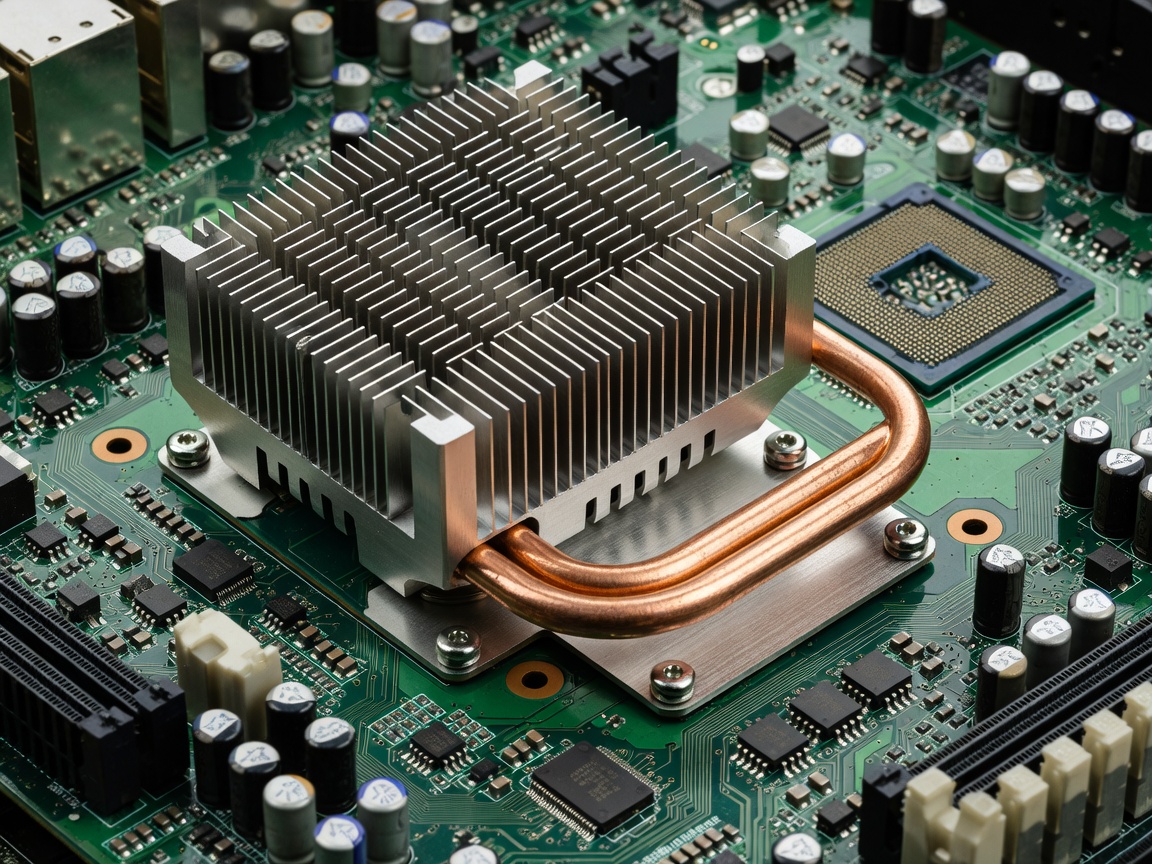
Thermal design is the ultimate governor of compute performance in slim laptops. A processor capable of boosting to 4.8 GHz across multiple cores is meaningless if a 12-millimeter chassis can only extract 12 Watts of sustained thermal energy before skin temperatures breach skin-burn safety limits. As modern ultrabook enclosures target profiles thinner than a standard magazine, thermal engineers must continually reinvent the mechanisms of heat transport.
The Heat Transfer Problem in Confined Spaces
In a full-size desktop or bulky gaming chassis, convection and radiator surface area dominate: large fans draw ambient air through deep fin stacks with ample clearance. In an ultrabook with an overall height of 10 to 13mm, the total vertical space allotted for thermal hardware—including vapor chamber, fan housing, and chassis insulation—is routinely under 3.5mm.
Airflow in this regime experiences high boundary-layer resistance. If thermal engineers rely on brute-force fan speed, acoustic profiles become high-pitched and grating (exceeding 2 kHz whine), which disrupts focus and user satisfaction.
Vapor Chambers vs Conventional Copper Heat Pipes
Standard circular copper heat pipes flattened down to 1.0mm thickness suffer substantial capillary loss: the internal sintered copper powder wick is compressed, restricting the liquid return path from the condensation zone back to the evaporator above the CPU.
To circumvent this, sub-14mm premium devices utilize bespoke two-phase vapor chambers:
- Planar Two-Dimensional Spreading: Unlike linear heat pipes that carry heat exclusively along a single conduit, a vapor chamber disperses thermal energy across an entire planar surface area, instantly pulling heat away from high-density CPU hotspot zones.
- Laser-Welded Micro-Capillary Meshes: Ultra-thin vapor chambers (0.35mm to 0.50mm) utilize etched micro-pillar capillary arrays that function effectively regardless of device orientation—whether sitting flat on a desk, tilted on a stand, or held vertically.
Liquid Crystal Polymer (LCP) Micro-Fans
Active ultrabooks cannot accommodate standard plastic fan impellers because standard materials warp when molded at sub-millimeter blade thicknesses. Instead, engineering teams specify Liquid Crystal Polymer (LCP):
- Ultra-High Blade Density: LCP enables blade trailing edges as thin as 0.2mm, allowing fan assemblies to house 75 to 90 individual blades within a 55mm diameter impeller.
- Resonance Suppression: High blade counts push the fundamental blade-pass frequency out of the human ear’s most sensitive harmonic range, resulting in a gentle broadband whoosh rather than an irritating whine.
- Fluid Dynamic Bearings (FDB): Sealed fluid bearings eliminate mechanical ball-bearing rattle and maintain lubrication across five-year lifespans in mobile environments.
Passive Fanless Architectures
Certain high-efficiency ultrabooks eliminate moving parts altogether, achieving completely silent zero-decibel operation.
Without active airflow, these systems rely strictly on conductive chassis spreading and natural convection:
- Synthetic graphite sheets with in-plane thermal conductivity exceeding 1,200 W/m·K are laminated against the internal aluminum bottom deck.
- Thermal pads bridge the motherboard to this spreader, converting the entire aluminum lower casing into a massive passive heatsink.
- Sustained power is strictly capped around 10W–15W: long burst workloads will briefly achieve peak clock speeds before the system smoothly down-throttles to equilibrium, preserving silent operation and cool exterior touchpoints.
Summary: Evaluating Thermal Balance
When comparing thin laptops, look closely at sustained TDP figures rather than peak burst ratings. An ultrabook claiming a 45W peak burst that throttles to 15W after 60 seconds will compile code or export video slower than a well-engineered 13mm chassis designed for a consistent, un-throttled 25W continuous load.