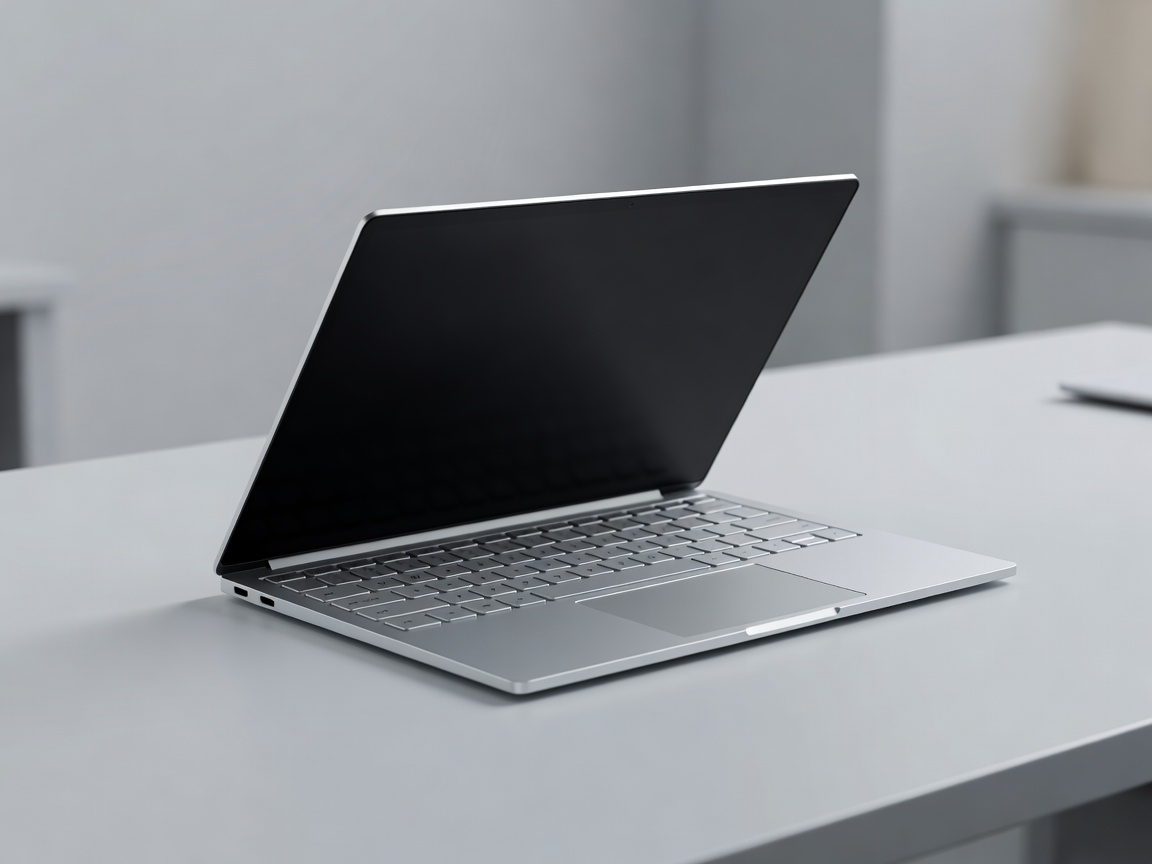
Dropping a fully featured laptop below the 1,000-gram (2.20 lbs) mark is not simply a matter of shaving off millimeters of metal. It represents an acute structural balancing act where mechanical rigidity, thermal dissipation surfaces, battery mass, and keyboard travel exist in relentless tension. For frequent travelers and mobile engineers, every 100 grams removed from a pack reduces fatigue over twelve-hour transit corridors, yet breaking this barrier requires material science solutions that diverge significantly from conventional CNC aluminum milling.
Magnesium-Lithium vs Carbon Fiber vs CNC Aluminum
In standard premium laptops, 6000-series extruded and CNC-milled aluminum remains the benchmark for premium tactile feel and torsional rigidity. However, aluminum carries a density of approximately 2.70 g/cm³. To construct an entire 13.3-inch clamshell housing with an unibody aluminum base, display lid, and keyboard top-case, the bare metal alone typically claims between 480 and 650 grams.
To push beneath 990 grams, manufacturers turn to two primary structural alternatives:
- Magnesium-Lithium (Mg-Li) Alloys: With densities hovering between 1.25 and 1.50 g/cm³, magnesium-lithium is roughly half the weight of aluminum and up to 30% lighter than standard magnesium-aluminum alloys. It allows wall thicknesses of 0.8mm without exhibiting excessive keyboard deck flex. The trade-off lies in tactile density: users frequently mistake the lighter alloy for plastic due to its warm, non-metallic acoustic resonance.
- Layered Structural Carbon Fiber: Utilizing multi-axial unidirectional carbon pre-preg sheets bonded with epoxy resin, carbon fiber delivers extraordinary tensile strength along the fiber axis. Often deployed in the display lid and bottom plate, carbon composite structures protect panels from keyboard impression blemishes during compression in crowded luggage.
The Internal Packing Problem: PCB Miniaturization
In an 880-gram device, the motherboard cannot occupy more than 18–25% of the chassis footprint. High-density interconnect (HDI) printed circuit boards featuring 10 to 12 layers are standard, stacking memory chips directly adjacent to the System-on-Chip (SoC). Soldered LPDDR5X memory is universal in this class; the physical sockets required for SO-DIMM or LPCAMM modules add 8 to 14 grams of mass and 2.5 millimeters of z-height, making them unviable.
Similarly, storage architectures are constrained. While full-size M.2 2280 NVMe SSD drives are preferred for price and thermal dispersion, several sub-900g machines utilize M.2 2230 or soldered BGA PCIe solid-state storage. This limits user upgradability but saves critical cubic millimeters for battery cells.
Battery Capacity vs Total Mass Calculations
The battery pack is the single densest component in any portable computer. Modern lithium-polymer pouch cells average between 220 and 260 Wh/kg at the pack level, inclusive of wiring, internal separators, and charge protection circuitry. A 60Wh pack will inevitably weigh between 240 and 275 grams.
Therefore, an ultrabook targeting 850 grams must make an uncompromising choice:
- Cap the battery at 40–48Wh (170–205g), relying on ultra-efficient display backlights and low-TDP processors to deliver 10 to 13 hours of real-world operation.
- Or maintain a 58–63Wh battery (250g) and shave precious grams from the thermal assembly, replacing dual-heatpipe copper radiators with lighter but lower-capacity aluminum vapor chamber solutions, capping sustained CPU power draw at 15 to 18 watts.
Ergonomic & Port Compromises
Prospective buyers of sub-kilogram hardware must evaluate clear functional trade-offs:
- Keyboard Travel: Chassis depths of 10–12mm generally force key switch travel down to 1.0mm–1.2mm, resulting in a firm, tactile bottoming-out sensation compared to the deeper 1.5mm–1.8mm travel of 1.4kg machines.
- I/O Port Array: Full-sized HDMI and USB Type-A ports require vertical clearance that exceeds the tapered edges of sub-1kg frames. As a result, drop-jaw collapsible Ethernet ports or pure USB-C/Thunderbolt arrays dominate this tier.
- Audio Chamber Volume: Speaker driver resonance cavities are substantially smaller, reducing low-end acoustic warmth and punch under 250Hz.
Pros & Cons of Sub-1kg Portables
Advantages: Effortless single-hand handling; virtually unnoticeable in standard backpacks; rapid deployment on aircraft tray tables; zero wrist fatigue during field measurements.
Disadvantages: Premium materials increase cost per gigabyte and gigahertz; structural flex may be noticeable under heavy center-deck pressure; sustained multi-threaded rendering performance is limited by small thermal dissipation mass.